Where: San Francisco, California
When: October 7, 2010 / June 16, 2014
With: Me / Dave
San Francisco is a city full of iconic images: the Golden Gate Bridge, the island of Alcatraz, the high hills and the cable cars that climb them. And for sure, if there was a sound synonymous with this city, it would be the familiar "ding-ding" that those cable cars make.
The natural slopes of the city made these ingenious inventions a necessity to navigate the steep inclines. When the idea of a cable car system was crafted in the late 1860s, it was after the inventor, Andrew Smith Hallidie, witnessed a horse drawn carriage slip on wet cobblestone while climbing a hill and kill the horses pulling it. To demonstrate a sampling of the inclines, here are Dave and I.


The engineering behind the cable cars is truly remarkable. As you would expect, it does involve cables, very long ones that run the length of their route and back again. The cables are affixed to wheels that are continuously spinning underneath the tracks, and when the cable car is ready to move, an operator pulls a lever that essentially clamps down onto the moving cable, pulling the car along with it.
When I was in San Francisco in 2010, I went to the "headquarters" at the center of all the city's cables. This building is also a museum that explains the history of the system and has some older versions of cable cars on display.


Of the 27 lines built between 1873 and 1890, only three remain in operation today. Each cable line in operation is marked by the street it runs along: California, Mason and Powell. It was fascinating to see them in action and know that at that moment, they were towing people around the city.

While I didn't get the chance to ride on one during that trip, Dave and I made a point to ride on our return in 2014. The lines all run by most of the popular tourist destinations of the city, so it wasn't too hard to track one down.


The view out the front made it very apparent why this would be a clever solution to the hills of the city.

The cars are made with wood, and combined with the wrought-iron decor, it is easy to see why they've been listed on the National Register of Historical Places.


Depending on which direction the car is headed, the operator will use one of two levers on either end of the car. These cable cars are the last manually operated ones in the world.


The ride was slow and bumpy, but beautiful. It was such a unique way to ride along, and watching modern cars pass just beside us was surreal. It took a minute to get over driving on a main road with nothing closing us into the vehicle.


As we got bolder during the ride, we started doing as the "locals" do and hanging out the side. Maybe more like they do in the movies than the locals.
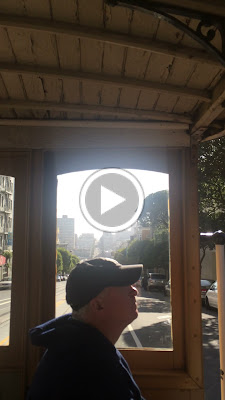
This was such a fun experience. It felt like taking a little step back into history, and hopefully, these cars maintain their status as historical relics to be preserved in current condition for years to come.
No comments:
Post a Comment