Where: Washington, DC
When: May 29, 1997 / subsequent trips
With: Class field trip / Ashley / Dave
In addition to the several historical monuments, memorials, government buildings and landmarks scattered throughout Washington, DC, there's also a pretty amazing group of museums. These museums cover everything from art to ancient artifacts to items of cultural significance. However, what makes the museums in Washington unique is that most of them are run by the same foundation: the Smithsonian Institution. Of the 19 museums operated by the Smithsonian, 17 are located in DC and eleven of them line the edges of the National Mall. The other cool thing about them? They are all completely free to enter!
The Smithsonian Institution began when James Smithson died in 1826 and willed his legacy of artifacts to the United States. In 1855, the first building was created to house the collection, called "The Castle" which still sits on the Mall (though now functions more as a visitors center). Over the years, collections have grown and moved into the several buildings that line the Mall. This all feeds a saying that the Smithsonian is like our nation's attic.
While I have barely cracked the surface of all these museums have to offer, here are the main ones that I have visited:
First up is the National Museum of Natural History. Opened in 1910, this was one of the first buildings exclusively built for its collection of all things related to life on earth.




When: May 29, 1997 / subsequent trips
With: Class field trip / Ashley / Dave
In addition to the several historical monuments, memorials, government buildings and landmarks scattered throughout Washington, DC, there's also a pretty amazing group of museums. These museums cover everything from art to ancient artifacts to items of cultural significance. However, what makes the museums in Washington unique is that most of them are run by the same foundation: the Smithsonian Institution. Of the 19 museums operated by the Smithsonian, 17 are located in DC and eleven of them line the edges of the National Mall. The other cool thing about them? They are all completely free to enter!
The Smithsonian Institution began when James Smithson died in 1826 and willed his legacy of artifacts to the United States. In 1855, the first building was created to house the collection, called "The Castle" which still sits on the Mall (though now functions more as a visitors center). Over the years, collections have grown and moved into the several buildings that line the Mall. This all feeds a saying that the Smithsonian is like our nation's attic.
While I have barely cracked the surface of all these museums have to offer, here are the main ones that I have visited:
First up is the National Museum of Natural History. Opened in 1910, this was one of the first buildings exclusively built for its collection of all things related to life on earth.

PS - despite the fact that my sister lives in DC, she hates crowds and is indifferent towards museums. Its funny to watch how her interest wanes as the time goes on in a museum.


As with most natural history museums, the biggest displays are usually the taxidermies of animals from around the world. With the internet, zoos and photography today, this can be a touch less impressive than it was back in the mid-1800s, but imagine if this was the only chance you had to see some of these animals in full scale? (I'm trying to leave the heebie-jeebie factor at the door on this one.)


The animals are often posed in live-action shots, showing how they hunt and scale next to other animals.


Rarrr...I've still got her intrigued.

The Hall of Human Origins shows how we went from being apes to the creatures making museums about evolution.


The Ocean Hall focuses on all things sea life, and even has a massive fish tank!


All Finding Nemo characters present? Check!


But of course, the big draw for me ever since I was a little kid has always been the dinosaurs. I mean, come on, how cool are these skeletons?


Like most natural history museums, there is a section on geology. I sort of yawn thinking about it, unfairly so, but rocks just can't compare with dinosaurs in my opinion. However, there is one item in this museum that definitely makes it worth visiting this section, and that would be the Hope Diamond. Traced back to 1666 India, it has changed hands several times over the years before landing in the lap of Harry Winston, who donated it to the museum in 1958. It is 45.552 carats and gets its blue coloring from traces of boron atoms.


The next Smithsonian museum I have visited is right next door, the National Museum of American History. This one may be my favorite of all of them. Opened in 1964, this museum focuses on artifacts that have been significant to American culture.

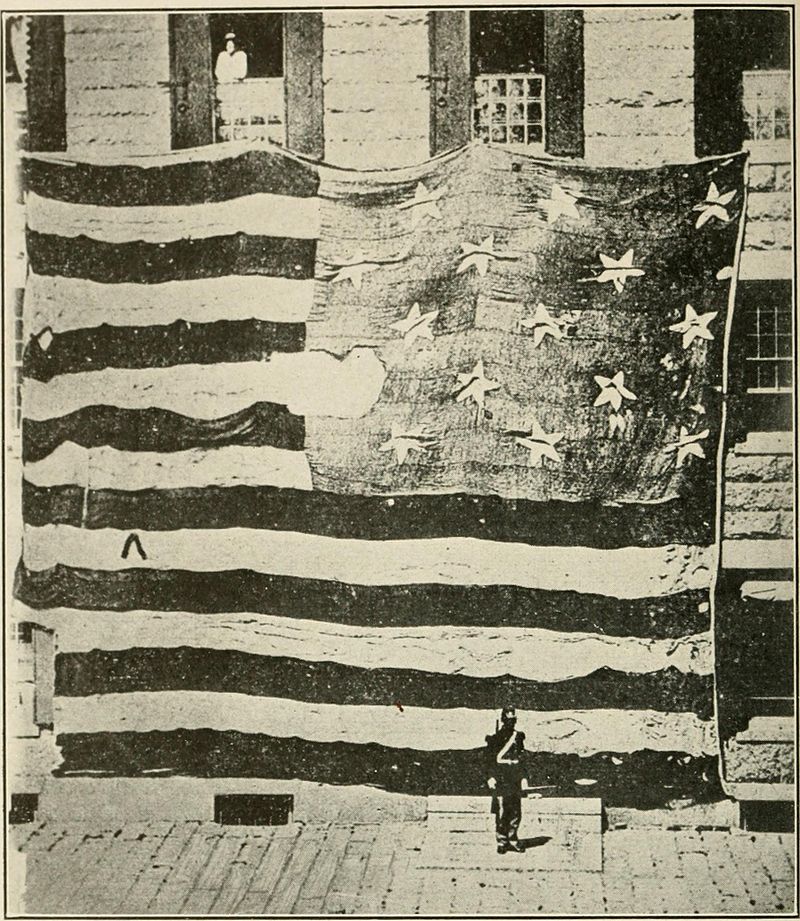
Upon walking in, the first exhibit is probably my favorite, called The Star-Spangled Banner. This is where the flag that inspired the writing of our national anthem is kept. During the Battle of Baltimore in the War of 1812, this flag was made to be oversized so that it could be seen from a great distance flying over Fort McHenry. On the morning after an intense battle, the flag could still be seen over the garrison, confirming that the Americans still held the fort. This inspired Francis Scott Key to write his poem Defence of Fort M'Henry, which was later set to music and retitled to create our national anthem.

A picture of the flag in 1814. I confirm it is massive in person.
Some cool artifacts from pop culture on display include: Dorothy's slippers from The Wizard of Oz, Kermit the Frog, and some original sketches and comic strips of Peanuts.


Some sports memoribilia included Apolo Anton Ohno's speed skates.

And for presidential memoribilia, Lincoln's top hat. Also included is a large exhibition of all the first ladies' dresses. That exhibit is cool to see how small (or large) each of the first ladies have been, and who had the best style.

Another piece of American history in the museum is the original Woolworth's counter where in February 1960, four African American college students politely sat down and asked for service. When they were refused and asked to leave, they stayed. Their sit-in eventually led to desegregation at Woolworth's lunch counters six months later. The counter was accompanied by an actor explaining what happened on that day 60 years ago.

The final Smithsonian that I have visited and love is the National Air and Space Museum. Opened in 1946, this museum is dedicated to all the ways we humans soar through the air. It has tons of original aircraft, which are not small pieces of machinery and makes the displays super impressive, especially the entrance hall.


One of my favorites in the entrance hall is the original Spirit of St. Louis, the airplane that Charles Lindbergh flew on the first nonstop transatlantic flight. So amazing this little guy made it all that way!


My, how commercial air transit has changed.


Further into the museum, there is a large room containing the plane that started it all: that of the Wright brothers. It looks so massive and yet so fragile, like it's made of paper and matchsticks. I can't believe someone flew this thing, and by casually laying on top of it, as the dummy in the model shows.


Another plane in the museum is Amelia Earhart's Lockheed 5B Vega. This is the plane she both flew across the ocean and nonstop across the United States. She was the first woman to do both.

Ahh, a little Snoopy makes me happy. He is here in the military aircraft section of the museum, which includes an example of what his arch-nemesis, the Red Baron, would have flown during World War I (aka German Air Force pilots).


When the space program took off in the 1960s, the museum was expanded to include these items too. Right away in the entrance hall is the Apollo 11 command module.

In the space section of the museum, there's also artifacts from the moon, including a moon rover and some space suits.


The engines on this rocket are gigantic.

And that is only three of the 19 museums the Smithsonian has to offer. I have to admit, each time I've gone back, I have a hard time not returning to these ones I love. They are amazing, and contain some crazy things that its hard to believe you're actually seeing in person. I'll just have to keep attacking and convincing my sister to return each time I visit her!
No comments:
Post a Comment