Here is a list of the things that can be done in the capital city. Scroll down below to see how well we tackled on our trip:
Top Attractions
Centro de Arte Reina Sofia
Flamenco
Museo Sorolla
Palacio Real
The Prado
The Tapas Crawl
Thyssen-Bornemisza Museum
The Plaza Mayor
Other Must-do's
Bullfights at La Plaza de las Ventas
Monasterio de las Descalzas Reales
Real Academia de Bellas Artes de San Fernando
Retiro Park
El Rastro Flea Market
Where to Stay
Hotel Opera
Ritz Hotel and Palace Madrid
Room Mate Alicia
Santo Mauro
Hotel Urban
Eating & Drinking
Cafe Gijon
Casa Botin
Chocolateria San Gines
El Neru
Pedro Larumbe
Sergi Arola Gastro
Day Trips
Toledo
Segovia


Built after a fire burnt down the previous palace in the mid-1700s, the current layout consists of a large plaza, with the main palace on one end and a cathedral on the other. The plaza was huge and still plays hosts to major royal and military events in Spain.


At this point, we were hungry and decided to stop for some food. We headed to the Mercado San Miguel, a large market filled with food and wine stalls. You can purchase a glass of wine and peruse around the market, ordering food in tapas style as you go. One glass each turned into many bottles while we sampled cheese platters, jamon, and fresh seafood. The afternoon flew by, and before we knew it, daylight was already fading.


At this point, we headed back to Rachel's hotel for a rest and regroup. While we walked, we got to see some more of Madrid in the fading sunlight. Memorials to Christopher Columbus, more grand buildings, and a beautiful biblioteca (library).


The next morning, our exploration of Madrid continued. One place that caught our eye was the Museu de Jamon. At first, we thought it really was a museum of ham, but learned later that it was just a shop and there were hundreds of them in the city. Creative branding though.


Now, Madrid has a lot of museums. A LOT. And which one to go to varies based on who you talk to. We were not sure which to choose, but in the end, we settled on the Prado. While it can be overwhelmingly large, it's kind of the classic Madrid museum (like the Spanish version of the Louvre).

However, once we arrived, we received some incredibly lucky news: it was International Museum Day, and all the museums in the city were free for the day. Therefore, we could enter and stroll for as long or as little as we liked before moving on to the next one.
The Prado was overwhelming, containing European art from the 12th to the 19th century. It was also laid out in a really illogical and strange way with lots of long hallways containing no art at all. So we decided to focus ourselves on a couple of artists and the logical decision were the Spanish ones: Goya and Velázquez.
I think my favorite collection was Goya's Black Paintings, a series of paintings referring to his use of the color black and the gloomy themes involved. Lots of death and unhappy people in these paintings, but extra impactful when you see them all together.

After the Prado, we needed some outdoor time, particularly as the weather finally seemed to turn in our favor. So we headed into Retiro Park, one of Madrid's largest parks.

The shrubbery in this park was fascinating. Each area had bushes and trees that looked like they were out of a cartoon.


And what major city park wouldn't be complete without quirky entertainment. This puppet show was not going on yet, but based on the variety of characters, including Elvis and Kurt Cobain, it would have been interesting to see.


As you stroll down this main highway, more grand structures and statues crop up around you. The contrast of the green parks and these epic buildings was beautiful.


While we were wandering down the Paseo, we suddenly heard cannon shots being fired. No one around us seemed too bothered by it, so we remained calm, but soon the entire Paseo was cut off from traffic, and we found ourselves in the middle of a victory rally for Madrid's underdog soccer team, Atletico Madrid. The night before, the team had beaten the more well-known Real Madrid (which led to our very long walk home as no cabs would take us through the celebrating crowd). Fans were just starting to line up for what would be the equivalent of a celebratory ticker-tape parade. It was crazy!


The final museum on our "Golden Triangle" tour of Madrid's three major art museums was the Reina Sofia. Focused on 20th century art, this museum houses works of art from one of Spain's most well-known artists, Pablo Picasso.

The main painting that everyone is there is see is the famous Guernica. Considered to have best captured the pain, death and destruction of the Spanish Civil War in the 1930s, this was Picasso's interpretation of the aftermath in a small town just north of Madrid. The dictator ruling Spain, Francisco Franco, allowed Hitler to use the town as target practice for the Nazi air force after the region had rose up against Franco.
The painting's stark black-and-white colors show the pain, death, and destruction that war can cause. A screaming mother holding her dead baby in her arms. Horses shrieking in terror. Dead bodies strewn about. All this sits in front of you on a very large canvas that reaches up to the ceiling.
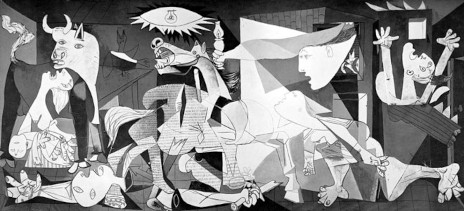
The painting itself was not allowed in Spain for decades after its completion (similar to its creator), but this allowed it to tour the world, raising awareness for the Spanish plight. It was finally returned to Spain in the 1980s, over 40 years after its completion.
Our last big activity while in Madrid was a Sunday morning walk through the Rastro Flea Market. A large open-air market filled with stalls that line the streets as far as the eye can see, you can find just about anything here, from leather goods to cheesy t-shirts to antiques.


---------------------------------------------------------------------------------------------
Where: Madrid, Spain
When: May 16 - 19, 2013
With: Suzannah, Rachel, and Aryeh
The final stop on our Spanish adventure was in the capital city of Madrid. I was really curious what it would be like since it felt like everyone's opinion of the city differed so greatly. Some consider it your stereotypcial European city, others consider it a cold and concrete jungle with no character, others say it's their favorite place in Spain. Either way, we were ready to explore.
Sadly, our bad luck with weather didn't catch a break and despite the predicted 80 degree highs, it rarely got over 60. The biggest twist of the knife was that a cold wind and persistent drizzle greeted us at our first stop of the day, the Puerta del Sol ("gate of the sun"). Womp womp.
This plaza is considered the center of not only the city of Madrid, but the country of Spain. All Spanish roads are meant to lead here and distances in Spain are measured from this point as reference. The main streets of Madrid lead off from this point like spokes on a wheel. It is a major tourist hub and just in case you weren't sure of that, many people wander around dressed as cartoon characters posing for pictures in the midst of it all (from Mickey Mouse to Bart Simpson).

We used the Puerta as a logical meeting spot with Rachel and Aryeh and then headed off in search of our first attraction. Walking through the city, my impression was that it had much more character than it was given credit for. While it was a very European feeling city, it was a very, very grand one, with elaborate buildings around every turn, bright white marble facades, and many commemorative statues.

Our first stop was at the Palacio Real. While we thought that indicated there was a "fake" palace floating around somewhere, "real" actually just stands for "royal". On top of being a main attraction of the city, this provided us with shelter from the rain, so we eagerly entered.


Built after a fire burnt down the previous palace in the mid-1700s, the current layout consists of a large plaza, with the main palace on one end and a cathedral on the other. The plaza was huge and still plays hosts to major royal and military events in Spain.


Just inside the palace is an entrance out of a movie: a sweeping staircase of white marble sitting under a ceiling that stretches well above your head covered with oil paintings and gilded gold as far as the eye can see.


Each room was more ludicrous in design than the last. The throne room, the apothecary, the armor rooms and the bed chambers each had crazy wallpaper, contents, and decor. Unfortunately, no pictures, but I was able to sneak this one in of one of the more modest rooms we saw.

At this point, we were hungry and decided to stop for some food. We headed to the Mercado San Miguel, a large market filled with food and wine stalls. You can purchase a glass of wine and peruse around the market, ordering food in tapas style as you go. One glass each turned into many bottles while we sampled cheese platters, jamon, and fresh seafood. The afternoon flew by, and before we knew it, daylight was already fading.


At this point, we were on a mission to find Plaza Mayor, another famous plaza in Madrid that had eluded us thus far. We finally stumbled our way into it and joyously (with the help of our wine) celebrated its existence.


At this point, we headed back to Rachel's hotel for a rest and regroup. While we walked, we got to see some more of Madrid in the fading sunlight. Memorials to Christopher Columbus, more grand buildings, and a beautiful biblioteca (library).


The next morning, our exploration of Madrid continued. One place that caught our eye was the Museu de Jamon. At first, we thought it really was a museum of ham, but learned later that it was just a shop and there were hundreds of them in the city. Creative branding though.


More reasons that I thought this city had more character than it gets credit for sometimes: random themed statues on the balconies over the streets.


Now, Madrid has a lot of museums. A LOT. And which one to go to varies based on who you talk to. We were not sure which to choose, but in the end, we settled on the Prado. While it can be overwhelmingly large, it's kind of the classic Madrid museum (like the Spanish version of the Louvre).

However, once we arrived, we received some incredibly lucky news: it was International Museum Day, and all the museums in the city were free for the day. Therefore, we could enter and stroll for as long or as little as we liked before moving on to the next one.
The Prado was overwhelming, containing European art from the 12th to the 19th century. It was also laid out in a really illogical and strange way with lots of long hallways containing no art at all. So we decided to focus ourselves on a couple of artists and the logical decision were the Spanish ones: Goya and Velázquez.
I think my favorite collection was Goya's Black Paintings, a series of paintings referring to his use of the color black and the gloomy themes involved. Lots of death and unhappy people in these paintings, but extra impactful when you see them all together.
After the Prado, we needed some outdoor time, particularly as the weather finally seemed to turn in our favor. So we headed into Retiro Park, one of Madrid's largest parks.

The shrubbery in this park was fascinating. Each area had bushes and trees that looked like they were out of a cartoon.


It was a lovely and pleasant park to wander through, with shady trees, fountains, and monuments.


And what major city park wouldn't be complete without quirky entertainment. This puppet show was not going on yet, but based on the variety of characters, including Elvis and Kurt Cobain, it would have been interesting to see.


Continuing our trend of art appreciation, we headed to an outdoor sculpture garden that sat underneath an overpass. Skateboarders whiz by as you look at the various modern structures in the shade of the highway.


One of my favorite parts about Madrid was its main road, Paseo del Prado, a busy highway that was softened by the green park in its center. I just thought it was such a nice touch to take an otherwise busy highway and make it feel a little less city-like.


As you stroll down this main highway, more grand structures and statues crop up around you. The contrast of the green parks and these epic buildings was beautiful.


While we were wandering down the Paseo, we suddenly heard cannon shots being fired. No one around us seemed too bothered by it, so we remained calm, but soon the entire Paseo was cut off from traffic, and we found ourselves in the middle of a victory rally for Madrid's underdog soccer team, Atletico Madrid. The night before, the team had beaten the more well-known Real Madrid (which led to our very long walk home as no cabs would take us through the celebrating crowd). Fans were just starting to line up for what would be the equivalent of a celebratory ticker-tape parade. It was crazy!


To escape the soccer crowds, we ducked into the next museum on our free, art-filled day, the Thyssen-Bornemisza. This private art collection (the second largest in the world) all belongs to one family who decided to put it on display for the world to see. It was a different collection because it spanned so many genres and time periods, and was laid out in a way that allowed us to easily wander through the entire collection.

The final museum on our "Golden Triangle" tour of Madrid's three major art museums was the Reina Sofia. Focused on 20th century art, this museum houses works of art from one of Spain's most well-known artists, Pablo Picasso.

The main painting that everyone is there is see is the famous Guernica. Considered to have best captured the pain, death and destruction of the Spanish Civil War in the 1930s, this was Picasso's interpretation of the aftermath in a small town just north of Madrid. The dictator ruling Spain, Francisco Franco, allowed Hitler to use the town as target practice for the Nazi air force after the region had rose up against Franco.
The painting's stark black-and-white colors show the pain, death, and destruction that war can cause. A screaming mother holding her dead baby in her arms. Horses shrieking in terror. Dead bodies strewn about. All this sits in front of you on a very large canvas that reaches up to the ceiling.
The painting itself was not allowed in Spain for decades after its completion (similar to its creator), but this allowed it to tour the world, raising awareness for the Spanish plight. It was finally returned to Spain in the 1980s, over 40 years after its completion.
Our last big activity while in Madrid was a Sunday morning walk through the Rastro Flea Market. A large open-air market filled with stalls that line the streets as far as the eye can see, you can find just about anything here, from leather goods to cheesy t-shirts to antiques.


As we left the market and headed back to grab our bags from the hotel, we enjoyed some Spanish sunshine that finally decided to come back, and listened to a drum troupe of young kids playing loudly in the streets. A nice way to end our trip in Spain.


No comments:
Post a Comment